
The wrong question that is costing you millions
In your company, transport is probably judged by a single question: did it arrive on time? If the answer is yes, case closed. Next.
The problem is that this question leaves out almost everything that actually defines your cost: how decisions were made, what rules exist, what information was used and how many times you got through the day by firefighting. These factors end up influencing your final cost more than the rate you negotiated.
If you are in charge of transport or logistics operations and find it hard to explain why your costs rise even when you deliver on time, this analysis will feel very familiar.
The real size of the problem
In consumer goods companies, distribution and transport usually represent between 6% and 8% of revenue, according to analysis by Bain & Company.
That percentage seems manageable until you apply it to your own reality:
If your company bills USD 500 million: You are spending $30-40 million a year on distribution and transport.
If it bills USD 1 billion: Your figure is between $60-80 million a year.
If it bills USD 5 billion: That spend easily exceeds $300 million.
We give you this reference so you can see why your transport area deserves your attention.
1. Moving freight every day doesn't mean you have a transport strategy
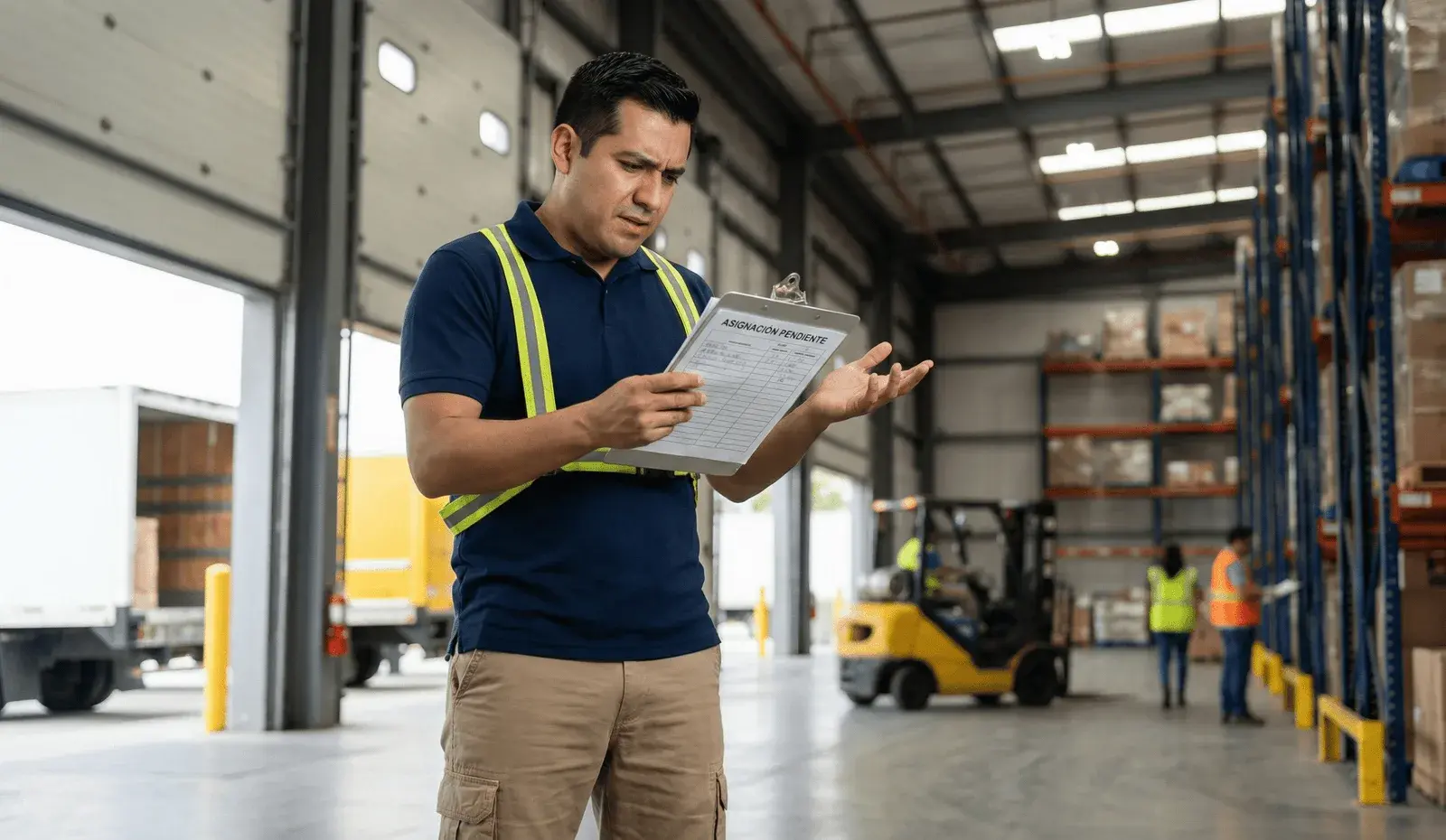
Production changes plans, your warehouse needs to ship, other areas shift priorities… and still your freight leaves and arrives on time. That creates a feeling of control: "we're operating well".
The problem is that operating well is not the same as deciding well. In practice, many of your transport decisions are made out of urgency, habit or whoever answers first. That gets you through the day, but it doesn't build a consistent way of deciding.
Without a clear strategy, the same lane is assigned differently depending on the person or the moment, urgencies become normal, and your cost varies without anyone being able to explain it. The World Bank's Logistics Performance Index shows that in Latin America, moving volume does not guarantee efficiency or strategic control.
What having a transport strategy really means
Put simply, having a transport strategy means you can clearly answer:
- What you prioritize when there is a conflict (price vs availability vs reliability)
- How you assign a lane when you have several options (cheapest first? most reliable? whoever responds fastest?)
- Why a decision was the right one, even weeks later when someone questions it
When those answers don't exist, your operation works… but your cost leaks through the process.
2. Your real cost goes far beyond the rate you negotiated
When you talk about transport cost, the conversation centers on the rate. But in high-volume companies, a large part of your spend is generated by everything around the assignment: urgencies, plan changes, dead time waiting for confirmations, and rework.
IDB studies show that in Latin America logistics costs represent between 16% and 26% of GDP, far above the OECD average (9%). That gap isn't explained by rates alone, but by structural inefficiencies.
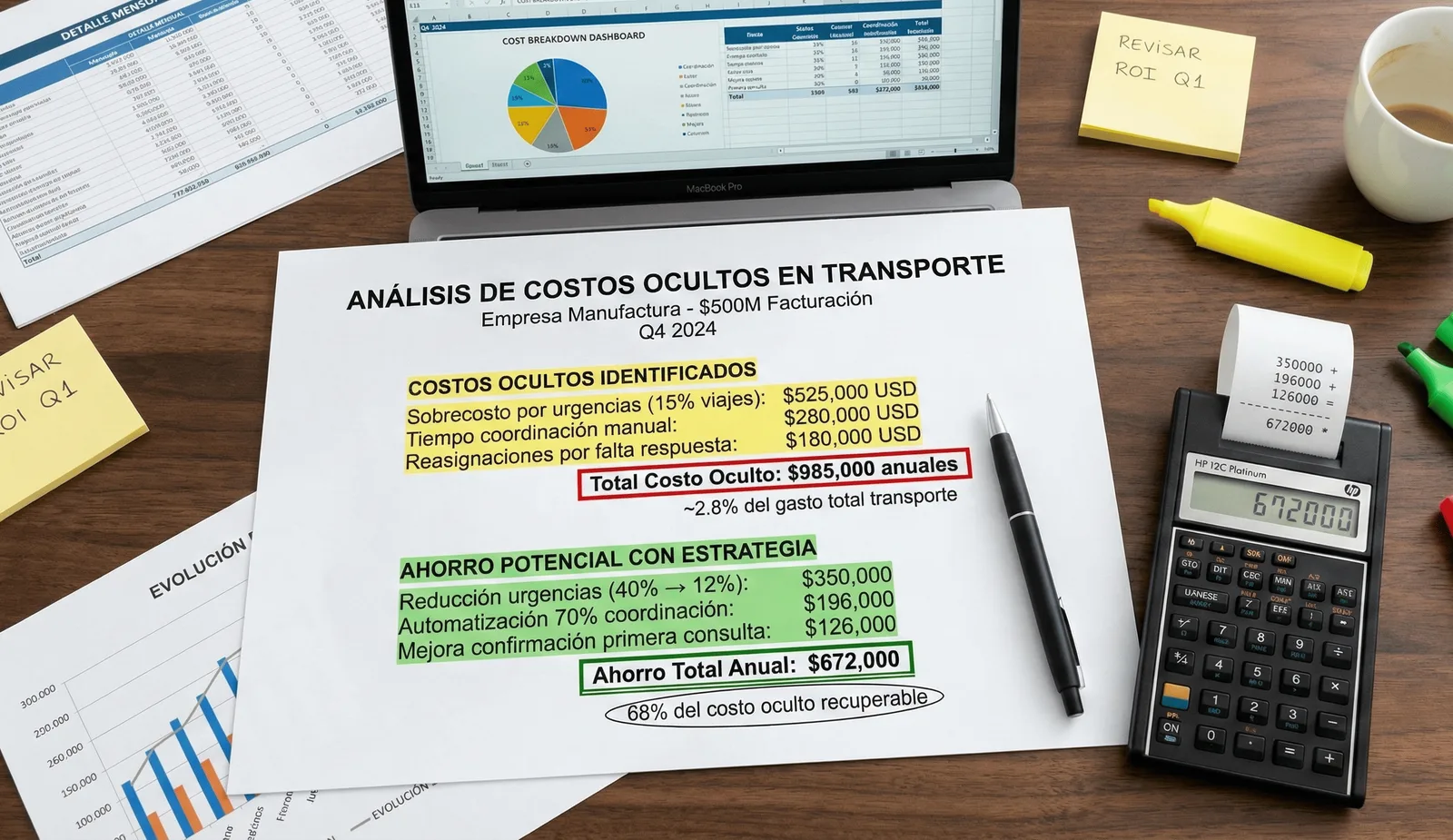
Real case: Consumer goods company, $500M revenue, $35M in transport, 8 coordinators managing 12,000 trips a year (2.5 hours on average per manual assignment).
Hidden costs identified:
- Urgency surcharges (15% of trips): $525K a year
- Manual coordination time: $280K a year
- Reassignments due to no response: $180K a year
- Total: $985K a year (~2.8% of transport spend)
After implementing a structured strategy:
- Urgencies reduced to 5%: $350K saved
- Automation cuts time by 70%: $196K saved
- Better confirmation on the first request: $126K saved
- Total annual savings: $672K (68% of the hidden cost)
3. Deciding without clear criteria multiplies your cost
Without rules, urgency decides for you
In your operation, transport assignment probably doesn't follow a formal criterion. It follows the rhythm of the day. Production changes, inventory adjustments and commitments you can't break push you to decide quickly. When you don't have clear rules, urgency becomes your main decision factor because there is no other shared reference.
In Latin America, delivery times are longer and more variable: average lead times of 3 to 7 days versus 1 to 3 days in more mature markets, which increases how often urgent decisions are made.
The effect: the same lane is assigned in different ways depending on the moment, your cost varies with no clear explanation, and your decisions are almost impossible to audit. Without explicit rules, your cost is absorbed by surcharges, rework and normalized urgencies.
Not evaluating rate + service + availability together
You probably evaluate suppliers at different times: you negotiate rates once a year, manage availability day to day, and review service when something goes wrong. The problem is that your actual assignment happens where those three variables meet, not in just one of them.
A supplier can have a competitive rate and still create extra costs if they don't respond when you need them. Another can always deliver but be saturated during your demand peaks. In both cases, your cost doesn't show up in the contract; it shows up later, when your operation has to solve things urgently.
Variability in service and availability between suppliers explains why your transport costs are higher than in developed economies. When rate, service and availability aren't looked at together, you end up reassigning trips at the last minute, accepting "justified" surcharges, and normalizing decisions that make your operation more expensive.

4. Without visibility into the process, you lose control of cost
Your transport operation has a fundamental problem: the result is visible, but your process is not.
You can't audit decisions:
Weeks after an assignment, you can't answer basic questions: how many suppliers you contacted, who responded, in what order, under what conditions and why you chose one option. The decision happened, but it left no clear trail. Without a record of the process, you can't detect patterns, correct biases or learn. Every day you start again from zero.
You only measure final results:
Transport is probably measured by total spend, completed trips and on-time delivery. These are necessary metrics, but they tell you little about why you got that result. When you only look at the month-end close, you lose visibility into how many times you reassigned a trip, how many decisions you made under urgency, or how much time you lost waiting for answers. That is where your cost grows out of control.
Scattered information:
The information does exist, but it is spread out: some in emails, some in WhatsApp, some in different files and some in reports that don't connect. Every decision is made with a partial view of your reality. Your team decides with whatever is at hand at that moment, not with the best possible information.
MIT studies show that when you can't verify transport information and intermediate decisions, your implicit costs rise because of rework and lack of transparency. In Latin America, although the data exists, fragmentation limits its use for operational decisions.
Without visibility into the process, you repeat questions that were already answered, miss chances to compare similar decisions, and your operation depends more on memory than on data.
What can you do?
Book a free diagnosis of your operation where we will identify the specific hidden costs in your operation and calculate the potential savings based on your real trip volume.