
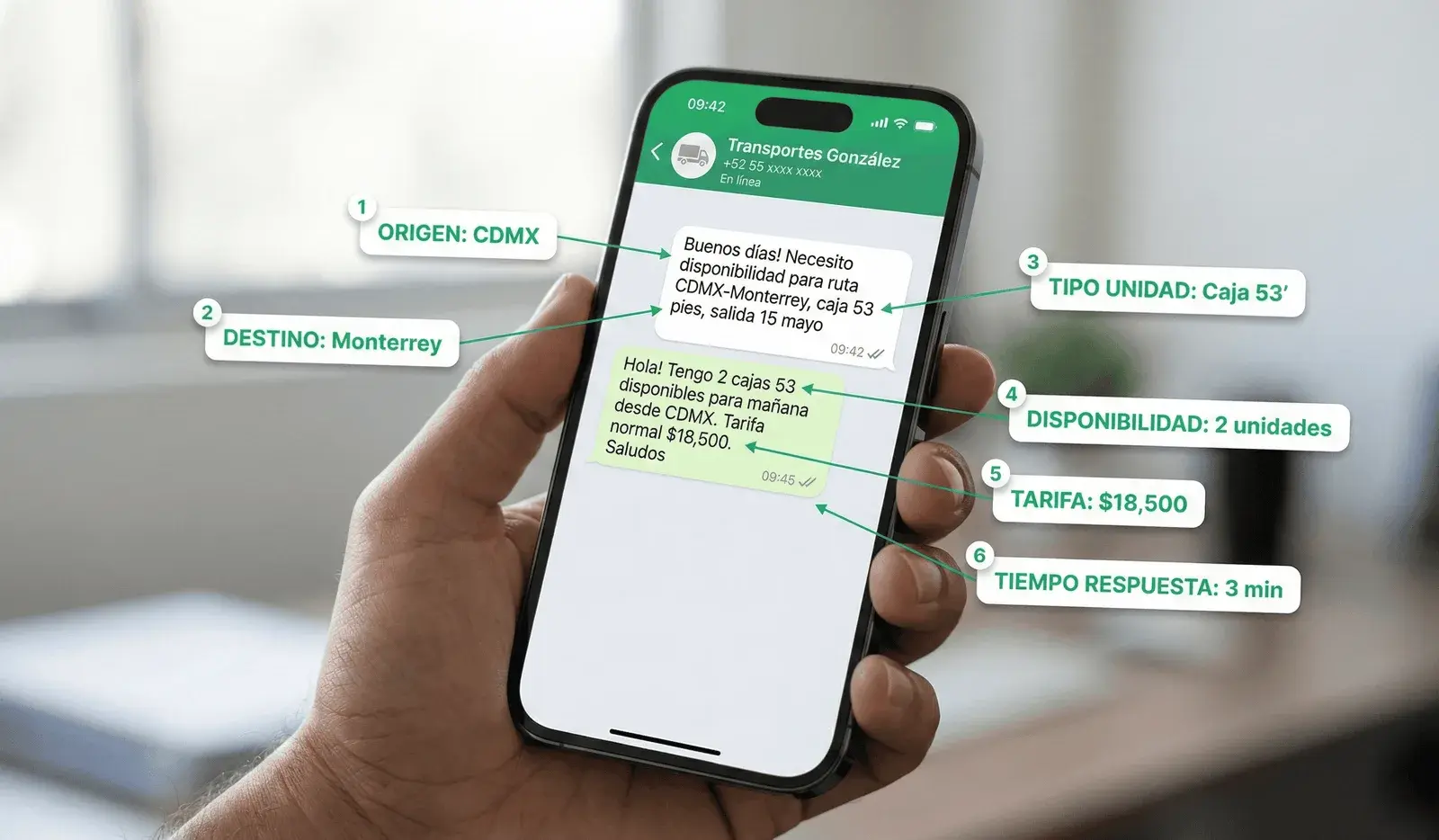
The problem nobody talks about
This is how transport assignment really works in most logistics companies:
- 7:00 AM - Customer requests arrive by WhatsApp, email and phone calls
- 8:00 AM - The coordinator starts contacting carriers one by one
- 9:30 AM - Still waiting for answers while more requests come in
- 11:00 AM - Some units confirmed, others still uncovered
- 2:00 PM - Pressure from urgent trips, and the cycle repeats
This process repeats every day, eats up hours of manual work, creates constant operational stress, and nobody has real visibility into what is happening until it has already happened.
Executives see that "the trips went out", but they don't see how many hours each assignment took, how many requests didn't get the best answer, which suppliers never responded, or where the real bottlenecks in the process are.

Why your TMS doesn't solve this
Your TMS records, it doesn't coordinate. It is excellent at recording the final result: "Trip X assigned to Supplier Y". But it doesn't help with the coordination that comes before: contacting suppliers, waiting for answers, managing availability in real time.
Carriers don't use the portal. Your TMS has a beautiful portal where suppliers can post availability. The problem: only 10-20% actually use it. The rest keep answering on WhatsApp because it's faster for them.
Information arrives through multiple channels. Customer requests come in by WhatsApp, email, web portals and phone calls. The TMS doesn't capture any of this automatically. Someone has to copy it by hand.
The result: you have a robust system that only reflects a fraction of what really happens in the daily operation.
How Trebu solves what your TMS can't
Your TMS is excellent at recording final results. Trebu automates the coordination that happens beforehand on WhatsApp and email, where decisions are really made.
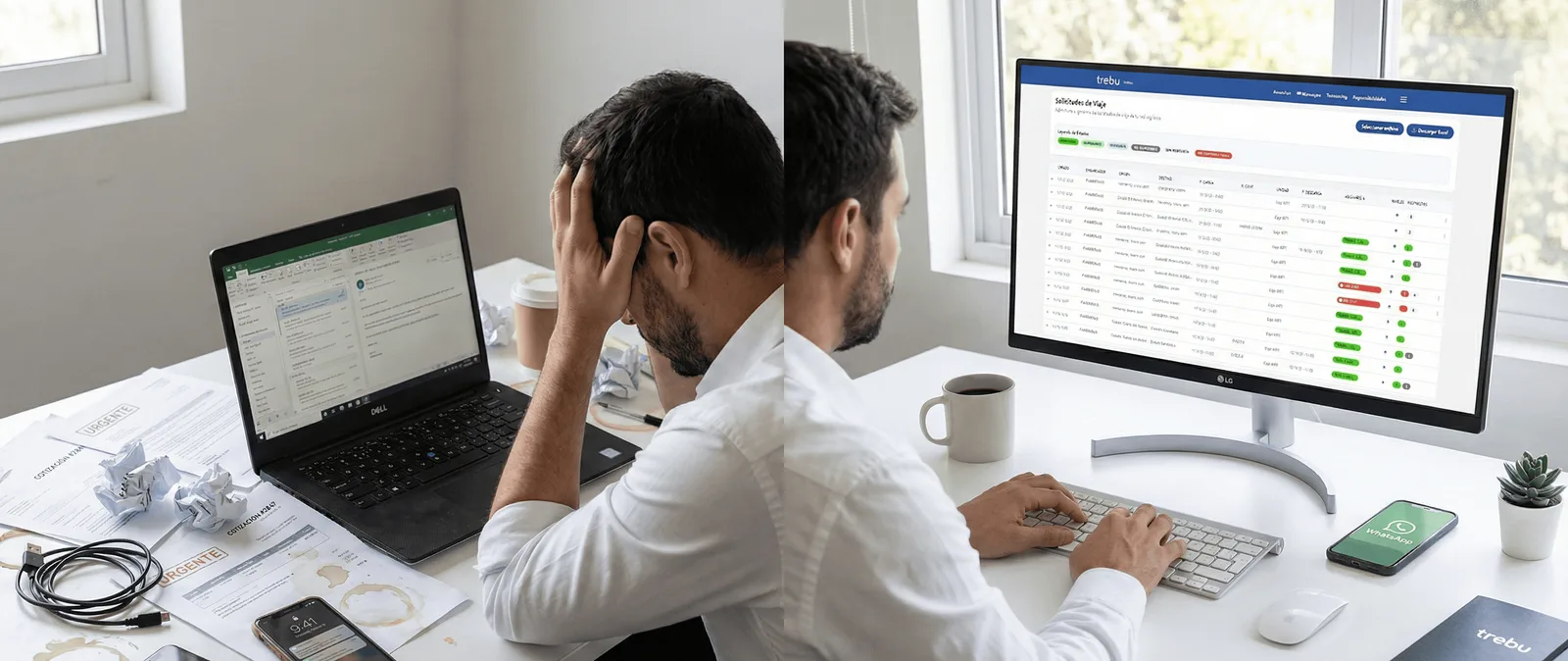
Before: Requests arrive through multiple channels → someone copies them by hand → the coordinator contacts suppliers one by one → waits for answers that arrive at different times → decision based on intuition or whoever answered first → zero visibility into the process.
With Trebu: Requests captured automatically from any channel → automated search contacts multiple suppliers at once → responses managed and prioritized according to your rules → decision based on real data → full visibility in real time.
The result: you cut assignment time from 2-3 hours to 15-30 minutes, eliminate 90% of transcription errors, and build operational intelligence on each supplier's real performance.
Why it works in Latin America
Trebu is designed for your reality: carrier communication over WhatsApp, highly fragmented suppliers, availability that changes minute by minute, and carriers who don't adopt corporate apps.
Trebu automates coordination in the channel where your suppliers already work, without trying to change how they communicate. It works with the reality of the market, not against it.
How do you calculate the ROI?
Lower operating costs
Coordination time: From 2-3 hours per trip to 15-30 minutes
- For a coordinator managing 20 trips a day: ~25 hours a week saved
- Annual cost per coordinator: ~$50K in salary + benefits
- Potential savings: 60-70% of the time can be redirected to higher-value work
Transcription errors: 90% reduction
- According to studies of logistics operations, manual data-entry errors cause problems on 5-8% of trips
- Average cost per error (re-shipments, claims): $200-500 per incident
- Estimated savings: $20K-40K a year for a mid-sized company
Better negotiation with suppliers
Evidence to renegotiate rates:
- Historical data on the volume actually moved (not estimates)
- Reliability metrics and response times
- Identification of suppliers who promise capacity they don't deliver
Real case: A 3PL in Mexico was renegotiating with a supplier who claimed to guarantee 50 units a month. With structured data they discovered it was actually delivering only 12 units. They adjusted the rate to the real volume. Annual savings: $180K.
Optimizing the supplier network
Identifying gaps:
- Lanes where demand exceeds a limited supply
- Reliable vs problematic suppliers per specific corridor
- Opportunities to consolidate with higher-capacity suppliers
Impact: Companies that optimize their network based on real data typically achieve an 8-12% reduction in transport costs within 12-18 months.

Why act now
In competitive markets, the difference between leaders and followers isn't fleet size. It's the speed and quality of operational decisions.
When your competitor can confirm availability in 30 minutes vs your 3 hours, offer rates optimized on data vs intuition, and answer customers with certainty vs "let me check and get back to you", you are not competing on equal terms.
The technology to do this exists and is proven. Every day you wait, your competition moves ahead while you keep operating manually.
Book a free diagnosis of your operation where we will review your current assignment process, analyze specific automation opportunities, and calculate the expected ROI for your specific case.