

The treasure hidden in your chats
You have implemented WhatsApp properly, with security controls, documented policies and regulatory compliance. But here is the opportunity most people miss: every conversation contains valuable operational data that currently disappears.
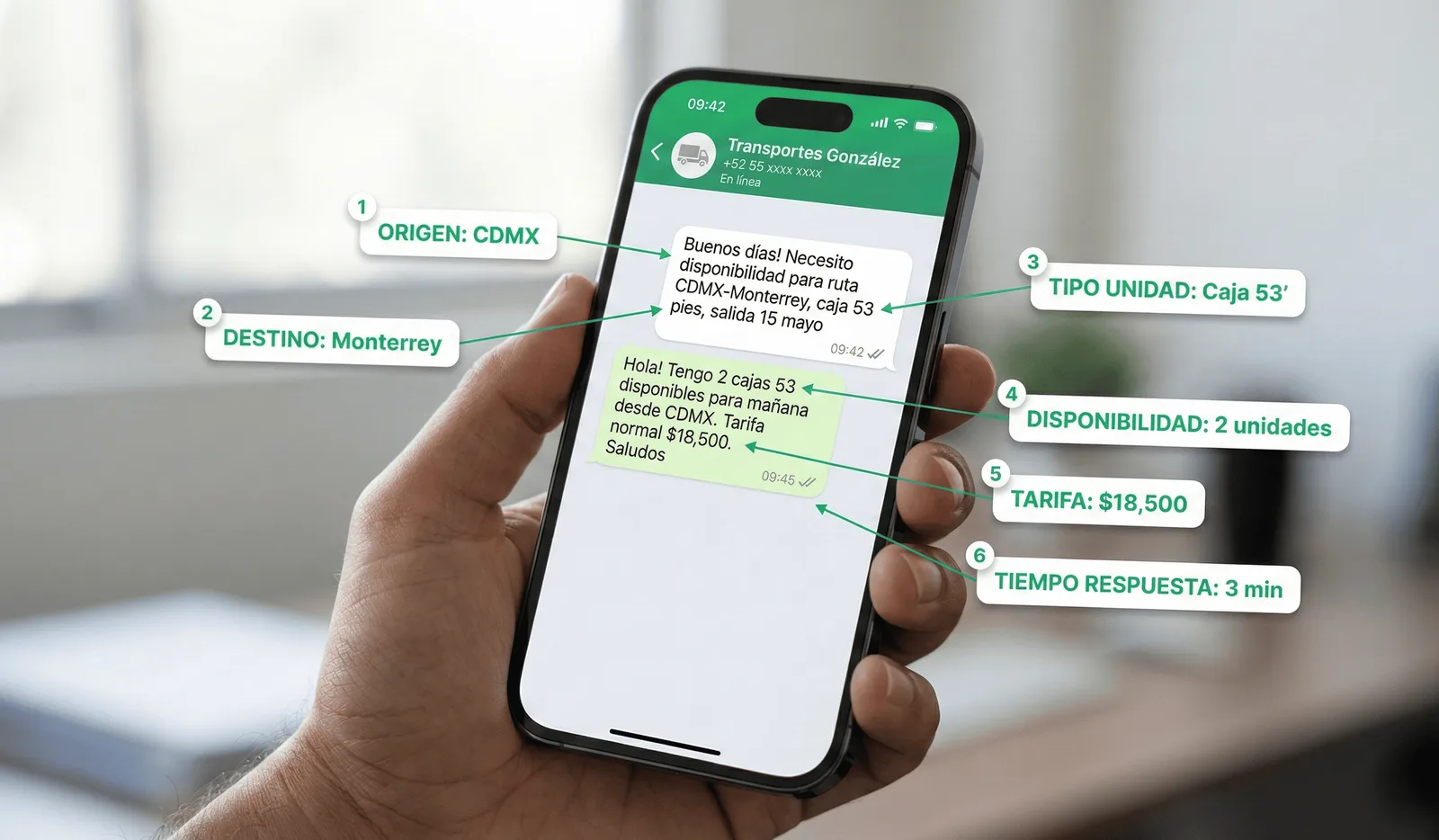
When a carrier replies "I have 2 53-ft boxes available for tomorrow from CDMX", that simple message contains five critical data points: real-time unit availability, the specific equipment type, the stated origin, the carrier's response time, and an implicit capacity commitment.
Multiply that by hundreds of messages a day and dozens of carriers. You have a massive volume of operational intelligence that evaporates today because it sits in unstructured chats. Without structure, you can't analyze patterns, audit decisions or negotiate with concrete evidence.
The problem: zero traceability
Many companies review monthly reports on how many units they placed and how many trips they completed. But those reports show only the final result, never the full chain of events that led to it.
Questions you probably can't answer either:
- How many requests did you receive on WhatsApp vs how many reached the TMS?
- How many were lost to human error or buried in chats?
- Which carriers respond fastest on a specific lane?
- Who consistently offers the best availability?
- At what times of day do you get the best response rate?
- Which lanes are hardest to cover, and why?
There is an invisible volume of business that is never quantified. It is not unusual for 10-15% of the requests that arrive through informal channels to never reach the official systems, simply because the message arrived at a bad moment or ended up in a secondary chat.
The risk: decisions without an audit trail
Here is something few companies admit: in many brokers, 3PLs and companies that move freight continuously, some planners keep preferential relationships with certain carriers. Sometimes out of friendship, sometimes out of convenience, sometimes for informal benefits.
This kind of relationship influences key decisions:
- Which supplier gets more loads
- Who gets asked first
- Who gets more volume even without offering the best rate
Before, there was no way to audit these decisions. There was no evidence of who responded first or who offered the best price. Decisions were left entirely to the planner, with no record of the full context.
When you turn conversations into structured data, you get a transparent record of the entire decision chain. You can see exactly which suppliers were contacted, who responded and when, what availability they offered, and what alternatives existed. This eliminates informal dynamics that hurt cost and efficiency.
What you can measure when you structure conversations
The transformation happens when you systematically capture, structure and analyze the information flowing through WhatsApp. With structured data you can measure each supplier's real performance: how long they take to respond, how often they confirm when they say they have availability, and how reliable they are on each specific corridor.
You also identify demand patterns that used to be invisible. You find out which lanes have more requests than availability, at what times you get the best response rate, and which are your critical days by unit type.
But the most valuable part is negotiating intelligence. You can identify which suppliers respond constantly but never confirm, who offers real availability versus who is just "testing the waters", and you have historical data on pricing and on how promised capacity was delivered.
The cost of not having this data
Here is a real story:
A large 3PL with operations in Mexico was renegotiating rates with one of its main carriers. The supplier claimed to guarantee 50 available units a month on critical lanes.
Without structured data, the 3PL had no way to validate that claim. They accepted the negotiation based on the traffic team's "perception", not on evidence.
Six months later, with structured historical data, they discovered that this supplier:
- Answered affirmatively to only 40% of requests
- Of that 40%, confirmed only 60%
- Actually delivered ~12 units a month, not 50
They had paid preferential rates for capacity that never existed. The cost of not having data: impossible to quantify, but substantial.
How can you capture this intelligence without adding manual work?
The key is automating the capture. Your coordinators shouldn't copy information from WhatsApp into Excel or the TMS by hand, because that process is error-prone, consumes valuable time, and gets abandoned under operational pressure.
Modern technology reads conversations automatically and interprets the content the way a person would. It understands that "I have 3 tortons for Monterrey" means exactly the same as "3 available MTY torton". It extracts the key data (origin, destination, unit type, dates), standardizes the information, records the operational metadata, and structures everything into clean data that feeds dashboards and reports.
All of this happens without your coordinators changing the way they work. The capture is completely invisible to them.
What this means for your operation
With structured data, your operations team has real-time visibility into pending requests, suppliers contacted, confirmed availability and automatic alerts for uncovered trips.
Your leadership gets strategic intelligence on which lanes need a broader supplier base, which carriers are most reliable per corridor, and where there are consolidation opportunities.
And your procurement team has concrete evidence to negotiate: the real volume moved per supplier (not estimates), measured response times, and how capacity commitments were actually met.
Your next step
You have already implemented WhatsApp securely and compliantly. Now the question is: will you let all that operational intelligence go to waste, or will you capture it systematically to make smarter decisions?
Book a free diagnosis of your operation and discover what valuable information you are losing in your conversations, how to automate its capture without adding manual work, and which specific metrics you should be measuring to optimize your transport assignment.
Continued in the next article: "Building a modern transport strategy: from improvisation to optimization"